
Fushimi Inari Taisha is much more than the famous tunnel of vermilion gates. The shrine's sacred precinct covers Inariyama, a 233-metre mountain threaded with smaller shrines, worship stones and thousands of torii. The dense Senbon Torii section near the bottom is only the opening chapter. You can spend 45 minutes seeing the lower shrine and first gates, or several hours following the pilgrimage route deeper into the mountain.
Why Fushimi Inari matters
Fushimi Inari Taisha is the head shrine associated with Inari worship. According to the shrine's own history, Inari Okami was enshrined on Inariyama in 711. Over the centuries Inari has been associated with the necessities and prosperity of everyday life — traditionally including food and harvest, and later commerce and business as well. That living religious role matters: this is not a theme park built around photogenic gates, but a major working Shinto shrine whose mountain has been treated as sacred for more than a millennium.
The main shrine building contains five shrines together and is designated an Important Cultural Property. Behind it, the mountain route passes many otsuka — worship stones engraved with names of deities — and shinseki, sacred sites associated with former shrines. The shrine says there are now more than 10,000 otsuka stones on Inariyama. Even if you come primarily for the torii, slowing down enough to notice these elements changes the visit from a photo stop into something closer to what the place actually is.
What the Senbon Torii gates actually are
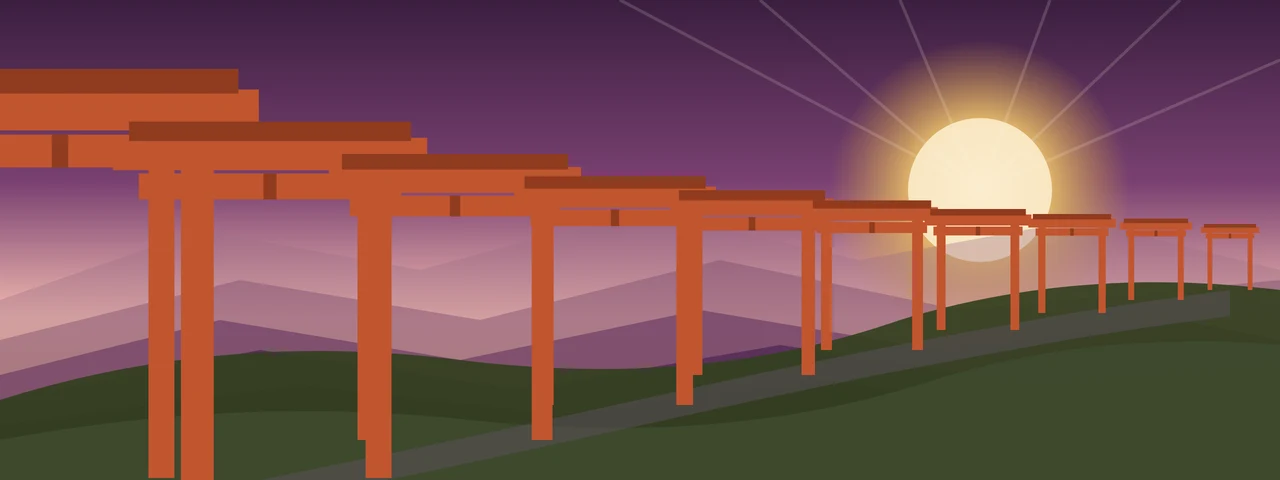
The most famous section begins beyond the main buildings, where two closely packed rows of gates form the classic orange-red tunnels. Senbon Torii literally means "thousand torii", but the mountain route as a whole contains several thousand gates. Fushimi Inari explains that worshippers have donated torii as expressions of prayer and gratitude since the Edo period. The vermilion colour is part of the visual tradition of Inari shrines and, in the shrine's own explanation, carries associations of brightness, hope and blessing.
If you look at the gates from the uphill side, you will see black inscriptions. These are not decorative slogans added for tourists: they identify donors and dates. The gates vary greatly in size, from the tightly spaced smaller gates of the early tunnel to large structures elsewhere on the mountain. Fox statues also appear throughout the precinct. They are regarded as messengers of Inari, not as the deity itself, and are often shown holding symbolic objects such as keys or jewels.
How far should you walk?
There is no single correct Fushimi Inari visit. The route works well because you can turn around whenever your time, weather or legs say you have had enough. For a short visit, explore the main shrine buildings, walk through Senbon Torii and continue to the Okusha area before returning. That gives you the signature experience without pretending you have "done the mountain".
For a more substantial visit, keep climbing. Around the middle section of the ascent, Yotsutsuji is a natural decision point: it offers a broader view over Kyoto and is where many visitors decide whether to continue into the upper circuit. A current Japan Guide route description estimates roughly 30–45 minutes of ascent to this area and about two to three hours for the summit route and return at an ordinary sightseeing pace. Treat those as planning estimates, not promises — heat, crowds, photo stops and fitness can change the timing significantly.
The highest point, Ichinomine, is 233 metres above sea level. Reaching it is satisfying if you like the pilgrimage aspect, forest atmosphere or simply want a proper walk, but do not expect a dramatic observation deck at the top. The mountain itself — the gates, stone altars, small worship sites and changing atmosphere — is the experience. If your only goal is a panoramic city view, Yotsutsuji can be the better use of time.
Is the full summit route worth it?
Yes for walkers, repeat Kyoto visitors and anyone interested in the shrine beyond the first photo tunnel; not necessarily for a rushed first-timer trying to fit four major sights into one day. Crowds generally thin as you climb, and the upper mountain feels substantially more contemplative than the lower approach. On the other hand, the physical effort rises while the density of postcard-style gates becomes less uniform.
A useful compromise is to give yourself a decision point rather than a fixed target. Start with enough time to reach Yotsutsuji. If the weather is good and you are enjoying the climb, continue. If you are already hot, tired or behind schedule, turn back without treating that as a failed visit. Kyoto rewards leaving some energy for the next district rather than converting every landmark into an endurance test.
Best time of day: early really does matter
Fushimi Inari's lower route is one of Kyoto's most photographed places, so the central problem is not whether it is "worth visiting" but how to experience it without spending the whole visit in a slow-moving crowd. The shrine grounds are widely listed as accessible at all hours, with no general admission charge, which creates an advantage that fixed-hours temples do not have: you can come before the standard sightseeing day begins or after much of it has ended.
Early morning is the easiest recommendation for most travellers. Trains make a dawn-ish or breakfast-time visit practical, the lower gates are calmer, and summer temperatures are kinder before midday. Evening can also be atmospheric, but the mountain is wooded and the experience becomes darker and quieter away from the lower precinct. If you plan to climb far after sunset, use ordinary hiking judgement rather than assuming an urban landmark will be brightly lit from bottom to summit.
Midday is not a disaster. If that is the only time your itinerary allows, go anyway — then keep walking beyond the first gate tunnels instead of fighting for one empty photograph. The upper route is where a crowded visit often becomes enjoyable again.
Getting there: take the train, not the sightseeing bus
From Kyoto Station, Kyoto City's official visitor guidance recommends the JR Nara Line to Inari Station. The journey is short and the station is immediately beside the shrine approach. From the Shijo-Kawaramachi/Gion area, the Keihan Main Line is convenient: use Fushimi-inari Station and walk east for about five minutes. The shrine's own access page lists the same two rail approaches and explicitly recommends public transport because nearby parking becomes very crowded.
Kyoto Travel specifically advises visitors to avoid relying on the South No. 5 city bus from Kyoto Station for this trip because road delays can be substantial. This is a good example of a wider Kyoto rule: rail is usually the better backbone when a major sight has a station close by. See our Kyoto transport guide for the same train-first strategy across the city.
What to do when you arrive
Do not sprint straight through the first torii. The Romon gate and main worship area deserve a few minutes before the climb, especially if this is your first Shinto shrine. Move with the flow, observe how worshippers use the space, and keep the central approach clear. From there, follow signs toward Senbon Torii and Okusha. Once the famous twin tunnels finish, the route becomes more varied: larger torii, forest, stone steps, smaller shrines and clusters of otsuka gradually replace the single visual motif you saw in photographs.
If you want the full mountain, carry water before you commit to the upper sections and wear shoes you are comfortable using on repeated steps and slopes. Conditions vary by season. August heat and humidity make the same climb feel very different from a cool autumn morning, while rain can make stone surfaces slick. This is still a shrine path rather than a wilderness trek, but it deserves more preparation than a flat city walk.
Shrine etiquette and photography rules
The shrine publishes unusually clear visitor rules, and they are worth reading because the biggest etiquette problems are predictable. Do not damage buildings, torii or trees; do not enter restricted areas; do not fly drones; do not feed or approach wild animals; and do not block narrow paths while taking photographs. Commercial photography can also be restricted. The shrine specifically prohibits conduct that interferes with worshippers.
Food is another point visitors often misunderstand. The shrine asks people not to eat or drink around the grounds except in designated rest areas, including avoiding eating while walking or standing. Treat the approach streets, where shops sell snacks and local specialities, as separate from the sacred mountain route. Buy what appeals, but finish it in an appropriate place rather than carrying a street-food crawl into Senbon Torii.
For photographs, patience beats obstruction. If the lower tunnel is busy, do not stop a whole line of people to stage a portrait. Walk farther, wait for a natural gap, or accept a photograph that shows the place as it actually looked during your visit. Kyoto City has also recently reminded visitors that carving into bamboo at Fushimi Inari is property damage and can carry legal penalties. Leave gates, bamboo and shrine objects exactly as you found them.
Accessibility and physical reality
The lower shrine area and the full mountain are very different accessibility propositions. The main approach is close to JR Inari Station, which makes reaching the precinct straightforward, but the upper route involves prolonged climbing, steps, slopes and uneven sections. A visitor who can comfortably enjoy the lower buildings may still find the mountain circuit unsuitable.
If mobility is limited, define success around the accessible lower experience rather than the summit. Check current station and shrine information before travelling, especially if you use a wheelchair or need step-free routing. Families with small children should make the same distinction: a stroller may be useful around transport and flatter approaches but becomes awkward on a mountain route built around steps. Our Kyoto accessibility guide and travelling with kids guide cover the broader planning trade-offs.
Foxes, wishes and the Omokaru stones
Fushimi Inari's fox imagery is easy to reduce to a cute mascot, but it is part of the shrine's religious symbolism. Foxes are understood as messengers of Inari. Around the precinct you will notice different objects in their mouths, and the details reward attention once you stop racing between photo spots.
Near Okusha, visitors also encounter the well-known Omokaru stones. The custom is to make a wish or prediction about whether something will come true, then lift the top of a stone lantern. If it feels lighter than you expected, tradition says the wish is more likely to be fulfilled; if it feels heavier, it may be difficult. Treat this as a cultural practice within an active shrine, not a prop to monopolise for repeated social-media takes.
Combining Fushimi Inari with the rest of Kyoto
Because JR Inari is so close to Kyoto Station, Fushimi Inari works extremely well as the first major stop of a day. It also sits on the JR Nara Line, so travellers continuing to Nara can visit in sequence, though carrying large luggage through the shrine is a bad trade-off. Leave bags at your hotel or a station locker and use our luggage-forwarding guide if this falls on a transfer day.
Do not confuse the shrine with the wider Fushimi district. South-west of the shrine is a separate historic sake-brewing area shaped by local spring water and canals. If you have more than half a day, combining the shrine with that quieter part of southern Kyoto makes more sense than racing immediately across the city to Arashiyama. See the Fushimi district guide and Kyoto sake guide.
Common planning mistakes
- Assuming Senbon Torii is the whole attraction. It is the photogenic beginning of a much larger sacred mountain.
- Scheduling a bus from Kyoto Station. Rail is faster and more predictable for this particular sight.
- Trying to force an empty photo at noon. Go early, go later, or walk farther instead of blocking the lower tunnel.
- Underestimating the climb. The summit is only 233 metres above sea level, but repeated steps, heat and humidity can make it tiring.
- Eating while walking through the shrine. The shrine asks visitors to use designated rest areas for food and drink.
- Dragging luggage up the route. This is a mountain shrine; store bags before sightseeing.
- Treating the torii as scenery only. They are donated religious structures inside an active place of worship.
Sources and current visitor information
Visitor details were checked in August 2026. For anything that can change, use the original source before you travel:
- Fushimi Inari Taisha official English site — shrine identity, sacred mountain and current notices.
- Fushimi Inari Taisha: access — JR, Keihan, bus and parking guidance.
- Fushimi Inari Taisha: precinct and mountain map — Senbon Torii, peaks and worship sites.
- Fushimi Inari Taisha: requests for visitors — current conduct, food, photography and preservation rules.
- Kyoto City Official Travel Guide: comfortable access to Fushimi Inari — train-first route advice from Kyoto Station and Gion-Shijo.